'%3E%3Cpath d='M69.8297 41.1619L71.8503 25.1371C72.0376 23.6588 72.8169 22.8988 74.1417 22.8988H76.5449C77.8269 22.8988 78.5961 23.6024 78.9237 25.0034L81.8866 37.6416L84.8494 25.0034C85.1771 23.6024 85.9463 22.8988 87.2283 22.8988H89.6315C90.9562 22.8988 91.7356 23.6588 91.9228 25.1371L93.9435 41.1619C94.1531 42.8176 93.4104 43.7425 91.9493 43.7425H91.0865C89.7617 43.7425 88.9946 42.9533 88.8196 41.4625L87.5315 30.5114L84.8026 41.6567C84.4648 43.0389 83.6936 43.7425 82.4096 43.7425H81.3636C80.0816 43.7425 79.3104 43.041 78.9705 41.6567L76.2437 30.5114L74.9556 41.4625C74.7806 42.9533 74.0135 43.7425 72.6867 43.7425H71.8239C70.3608 43.7425 69.6201 42.8197 69.8297 41.1619Z' fill='%232A4D69'/%3E%3Cpath d='M99.1569 46.7199L100.264 43.7049L95.4615 30.0812C94.8694 28.4026 95.5551 27.2939 97.1383 27.2939H98.0438C99.3014 27.2939 100.075 27.9704 100.469 29.3192L102.917 37.6938L105.347 29.3192C105.738 27.9704 106.515 27.2939 107.773 27.2939H108.662C110.262 27.2939 110.951 28.4172 110.371 30.0812L104.415 47.1667C103.953 48.4884 103.145 49.0667 101.922 49.0667H100.966C99.3645 49.0667 98.6462 48.1188 99.161 46.7199H99.1569Z' fill='%232A4D69'/%3E%3Cpath d='M122.3 43.9492C119.266 43.9492 116.413 42.6255 115.186 40.4102C114.386 38.9633 114.848 37.7794 116.226 37.3556L116.637 37.2303C117.787 36.8774 118.495 37.3034 119.201 38.1239C120.042 39.099 121.059 39.6231 122.258 39.6231C123.66 39.6231 124.531 38.9445 124.531 37.8483C124.531 34.6914 115.048 36.5496 115.048 28.9517C115.048 25.1705 117.901 22.713 122.042 22.713C125.127 22.713 127.67 23.8029 128.841 25.8595C129.781 27.511 129.376 28.7116 127.827 29.0665L127.412 29.1626C125.811 29.528 125.281 28.7304 124.482 27.9871C123.82 27.3711 123.118 27.0475 122.243 27.0475C120.961 27.0475 120.143 27.7031 120.143 28.7304C120.143 32.3634 129.766 30.0291 129.766 37.5748C129.766 41.4542 126.637 43.9534 122.298 43.9534L122.3 43.9492Z' fill='%232A4D69'/%3E%3Cpath d='M144.487 27.296C145.881 27.296 146.638 28.1499 146.638 29.7221V41.3352C146.638 42.9074 145.881 43.7613 144.487 43.7613H143.832C142.444 43.7613 141.687 42.9136 141.681 41.4709C141.02 42.9324 139.383 43.9492 137.452 43.9492C133.649 43.9492 132.031 41.688 132.031 36.4953V29.7221C132.031 28.1499 132.788 27.296 134.182 27.296H134.837C136.231 27.296 136.988 28.1499 136.988 29.7221V35.94C136.988 38.3536 137.723 39.4205 139.343 39.4205C141.048 39.4205 141.681 38.245 141.681 35.823V29.7221C141.681 28.1499 142.438 27.296 143.832 27.296H144.487Z' fill='%232A4D69'/%3E%3Cpath d='M149.845 46.6406V29.7012C149.845 28.129 150.602 27.2751 151.996 27.2751H152.651C153.992 27.2751 154.802 27.9704 154.802 29.1292V29.6741C155.494 28.2188 157.268 27.0538 159.088 27.0538C162.663 27.0538 165.141 30.0332 165.141 35.4785C165.141 40.9238 162.673 43.9388 159.079 43.9388C157.26 43.9388 155.445 42.874 154.802 41.189V46.6406C154.802 48.2128 154.045 49.0667 152.651 49.0667H151.996C150.602 49.0667 149.845 48.2128 149.845 46.6406ZM160.203 35.4994C160.203 33.0565 159.092 31.4927 157.419 31.4927C155.746 31.4927 154.637 33.0294 154.637 35.4994C154.637 37.9694 155.738 39.4769 157.403 39.4769C159.067 39.4769 160.203 37.911 160.203 35.4994Z' fill='%232A4D69'/%3E%3Cpath d='M167.779 46.6406V29.7012C167.779 28.129 168.536 27.2751 169.93 27.2751H170.585C171.926 27.2751 172.736 27.9704 172.736 29.1292V29.6741C173.428 28.2188 175.202 27.0538 177.021 27.0538C180.597 27.0538 183.075 30.0332 183.075 35.4785C183.075 40.9238 180.607 43.9388 177.013 43.9388C175.194 43.9388 173.379 42.874 172.736 41.189V46.6406C172.736 48.2128 171.979 49.0667 170.585 49.0667H169.93C168.536 49.0667 167.779 48.2128 167.779 46.6406ZM178.137 35.4994C178.137 33.0565 177.026 31.4927 175.353 31.4927C173.68 31.4927 172.571 33.0294 172.571 35.4994C172.571 37.9694 173.672 39.4769 175.337 39.4769C177.001 39.4769 178.137 37.911 178.137 35.4994Z' fill='%232A4D69'/%3E%3Cpath d='M185.204 35.5078C185.204 29.5781 189.027 27.0621 192.926 27.0621C196.825 27.0621 200.622 29.576 200.622 35.5078C200.622 41.4395 196.835 43.9743 192.9 43.9743C188.964 43.9743 185.204 41.4938 185.204 35.5078ZM195.682 35.489C195.682 32.9563 194.51 31.5094 192.908 31.5094C191.307 31.5094 190.124 32.948 190.124 35.489C190.124 38.03 191.323 39.4957 192.916 39.4957C194.51 39.4957 195.682 38.0696 195.682 35.489Z' fill='%232A4D69'/%3E%3Cpath d='M212.71 29.576L212.671 29.9852C212.531 31.4572 211.766 31.881 210.494 32.2193C209.037 32.6014 208.225 33.8395 208.225 36.3847V41.3143C208.225 42.8865 207.468 43.7404 206.074 43.7404H205.419C204.025 43.7404 203.268 42.8865 203.268 41.3143V29.7012C203.268 28.129 204.025 27.2751 205.419 27.2751H206.074C207.468 27.2751 208.225 27.9537 208.225 29.4444C208.622 28.3378 209.539 27.1435 211.155 27.1435C212.38 27.1435 212.862 27.8785 212.71 29.5739V29.576Z' fill='%232A4D69'/%3E%3Cpath d='M221.977 44.0119C217.789 44.0119 215.852 42.1766 215.852 37.1781V31.4384H215.459C214.435 31.4384 213.874 30.6241 213.874 29.3421C213.874 28.0601 214.446 27.2751 215.433 27.2751H215.852V26.3794C215.852 24.9241 216.419 24.2392 217.927 23.878L218.471 23.7486C220.211 23.331 220.835 24.0158 220.835 25.7801V27.2751H222.349C223.918 27.2751 224.5 28.0038 224.5 29.3421C224.5 30.6805 223.918 31.4384 222.349 31.4384H220.835V36.7647C220.835 38.7649 221.448 39.5792 222.825 39.6836C223.88 39.8089 224.553 40.3851 224.575 41.5941C224.6 42.8886 224.059 43.8052 222.699 43.9638C222.445 43.9931 222.207 44.0119 221.977 44.0119Z' fill='%232A4D69'/%3E%3Cpath d='M227.078 41.7966C225.978 40.596 225.973 39.0155 227.791 38.6939L228.328 38.6C229.358 38.4183 229.848 38.8463 230.672 39.6439C231.346 40.2954 232.18 40.5522 232.967 40.5522C234.064 40.5522 234.766 40.0386 234.766 39.2368C234.766 36.464 226.566 38.1907 226.566 32.1212C226.566 28.935 229.24 27.0726 233.041 27.0726C235.175 27.0726 237.229 27.7031 238.472 29.0101C239.587 30.1815 239.477 31.7057 237.827 32.0439L237.412 32.1295C236.197 32.378 235.698 31.6555 235.092 31.2129C234.402 30.7097 233.761 30.4884 233.142 30.4884C232.109 30.4884 231.437 30.9436 231.437 31.7411C231.437 34.4763 239.766 32.2464 239.766 38.5039C239.766 41.8926 237.141 43.9513 232.967 43.9513C230.519 43.9513 228.356 43.1913 227.078 41.7987V41.7966Z' fill='%232A4D69'/%3E%3C/g%3E%3Cpath d='M44.3426 57.1054C44.4225 54.4304 43.8191 41.3519 43.8171 39.1578C43.8171 22.2642 46.908 11.3572 49.6992 11.4861C54.0628 11.6888 54.5203 17.3827 54.9359 20.8192C55.3495 24.2536 56.5083 31.9595 55.7012 35.8216C54.894 39.6817 53.7551 50.9162 53.7112 53.1757C53.6532 56.1926 51.877 63.0225 49.7332 63.1105C46.8641 63.2292 44.2347 60.722 44.3426 57.1075V57.1054Z' fill='%231FB2A6'/%3E%3Cpath d='M46.9302 9.17335C48.5326 10.8107 49.6854 10.6838 50.9302 10.1947C52.2369 9.68094 54.5565 4.07907 51.7673 2.04668C49.3358 0.276269 47.5875 1.72535 46.8922 2.60953C44.2569 5.95591 45.144 7.34768 46.9302 9.17131V9.17335Z' fill='%231FB2A6'/%3E%3Cpath d='M48.3845 64.9628C50.1048 65.4069 52.1307 64.621 53.1397 66.2011C54.3106 68.0329 52.0688 71.1275 50.838 71.7825C49.6073 72.4374 45.7112 70.6056 45.6093 68.52C45.5074 66.4344 46.6043 64.5043 48.3845 64.9628Z' fill='%231FB2A6'/%3E%3Cpath d='M53.5953 41.9249C53.4495 48.2227 52.3646 62.4433 57.4375 62.4412C58.8281 62.4412 65.3775 49.0352 65.5733 46.3233C66.7221 30.5042 58.9979 27.2356 57.8051 27.2274C55.3116 27.207 53.7012 37.3403 53.5934 41.927L53.5953 41.9249Z' fill='%234CAF50'/%3E%3Cpath d='M55.887 24.2597C56.7081 26.0383 59.0358 25.6842 59.4274 24.6711C59.819 23.658 61.779 21.7729 59.0777 18.7888C57.9249 17.5158 55.9369 17.3131 55.3655 19.1163C54.6802 21.2797 55.7131 23.8811 55.887 24.2576V24.2597Z' fill='%234CAF50'/%3E%3Cpath d='M32.6844 11.482C38.8122 11.2876 37.2358 24.929 37.0221 29.4625C36.8183 33.7442 36.7124 37.3178 34.9701 43.286C33.9232 46.8759 33.3518 50.6583 30.2769 50.9653C27.2039 51.2723 26.6165 48.1817 26.3029 37.0742C26.0951 29.7326 26.5066 19.7017 27.0161 17.0634C27.5276 14.4232 29.7913 11.5741 32.6824 11.482H32.6844Z' fill='%23E63946'/%3E%3Cpath d='M36.8461 7.95146C37.903 5.7451 37.6593 1.99551 35.5294 0.4441C33.3996 -1.10527 31.1099 1.70078 30.0469 4.22234C28.984 6.74595 29.957 8.98506 31.6813 10.121C33.4056 11.259 36.3586 8.96868 36.8461 7.94942V7.95146Z' fill='%23E63946'/%3E%3Cpath d='M24.9583 46.7224C26.9403 39.43 26.9343 27.6614 26.9782 24.1881C27.0222 20.7148 26.5127 15.424 21.5217 16.6991C16.5308 17.9763 17.5957 19.4335 17.1302 22.2826C16.6646 25.1316 17.1042 31.8735 18.1212 36.2985C19.1381 40.7235 18.3929 44.4076 19.7795 46.8248C21.1661 49.2419 22.3649 50.3021 23.5657 49.8989C24.7665 49.4957 24.9583 46.7224 24.9583 46.7224Z' fill='%23FF6F61'/%3E%3Cpath d='M18.6745 11.6663C18.5766 12.3785 18.6905 15.4895 21.4317 15.6615C24.2049 15.8334 23.8573 14.4089 24.9282 12.8963C25.7294 11.7625 25.2658 10.4873 23.8573 8.66782C22.6585 7.1164 20.9762 7.65265 20.4627 8.0231C19.5956 8.64735 18.8223 10.5897 18.6745 11.6663Z' fill='%23FF6F61'/%3E%3Cpath d='M13.7136 19.54C15.3739 19.6792 18.8784 24.2167 19.0782 32.9235C19.21 38.6195 18.283 44.2623 18.0672 46.3111C17.7795 49.0557 17.228 52.6538 14.7465 53.5871C12.311 54.5041 9.97734 45.0626 10.1672 38.2183C10.357 31.3741 9.9174 27.9049 10.0872 25.7743C10.2571 23.6437 11.344 19.3415 13.7136 19.54Z' fill='%23F9901C'/%3E%3Cpath d='M11.4699 15.2685C10.9604 16.167 10.8925 18.4941 13.7796 18.8339C16.6667 19.1736 16.5688 17.1617 16.4749 15.9828C16.381 14.8039 15.0583 13.6536 13.9654 13.6536C12.8725 13.6536 11.9794 14.37 11.4699 15.2664V15.2685Z' fill='%23F9901C'/%3E%3Cpath d='M8.24303 56.3891C12.6726 54.1746 10.8104 48.7896 10.8824 33.4024C10.9063 28.4514 5.81347 27.2991 2.35695 30.011C-1.09956 32.7229 -1.10356 40.5925 4.7006 49.2338C7.21406 52.9772 4.81248 58.1043 8.24103 56.3891H8.24303Z' fill='%23FFC947'/%3E%3Cpath d='M10.4546 26.9368C12.057 23.527 8.07304 20.1908 5.71542 22.3317C3.35779 24.4726 3.24191 27.078 6.4307 27.9192C8.09103 28.3572 9.95914 27.9909 10.4546 26.9368Z' fill='%23FFC947'/%3E%3Cpath d='M45.3198 25.8766C45.044 29.6405 42.9202 33.2428 44.6265 34.4278C49.7133 37.9564 50.075 43.9471 47.8852 47.4859C44.093 53.6117 39.6015 54.9687 38.2669 53.9474C36.2529 52.4041 39.4717 49.3852 40.2569 46.2312C42.127 38.7136 31.4098 42.3977 34.6485 27.2234C35.9592 21.0853 38.3688 20.3648 40.5486 20.3648C43.6395 20.3648 45.5655 22.5241 45.3198 25.8746V25.8766Z' fill='%232A4D69'/%3E%3Cpath d='M41.24 11.5926C39.1221 12.1452 38.7965 14.0098 38.6566 16.0565C38.3889 19.9821 40.8923 20.1294 42.1691 19.7303C45.0861 18.8175 46.1011 17.2272 45.3519 14.6565C44.6665 12.3069 43.2839 11.0584 41.24 11.5926Z' fill='%232A4D69'/%3E%3Cdefs%3E%3CclipPath id='clip0_1_958'%3E%3Crect width='169.971' height='26.3558' fill='white' transform='translate(69.7949 22.7109)'/%3E%3C/clipPath%3E%3C/defs%3E%3C/svg%3E%0A)
Acting early puts you in control. Doing nothing risks disruption to the supports you rely on every day - and for workers, your income and career.
The good news: you have options, and a confident plan made now means your supports continue, secure and uninterrupted. This guide helps you take the next step with clarity.
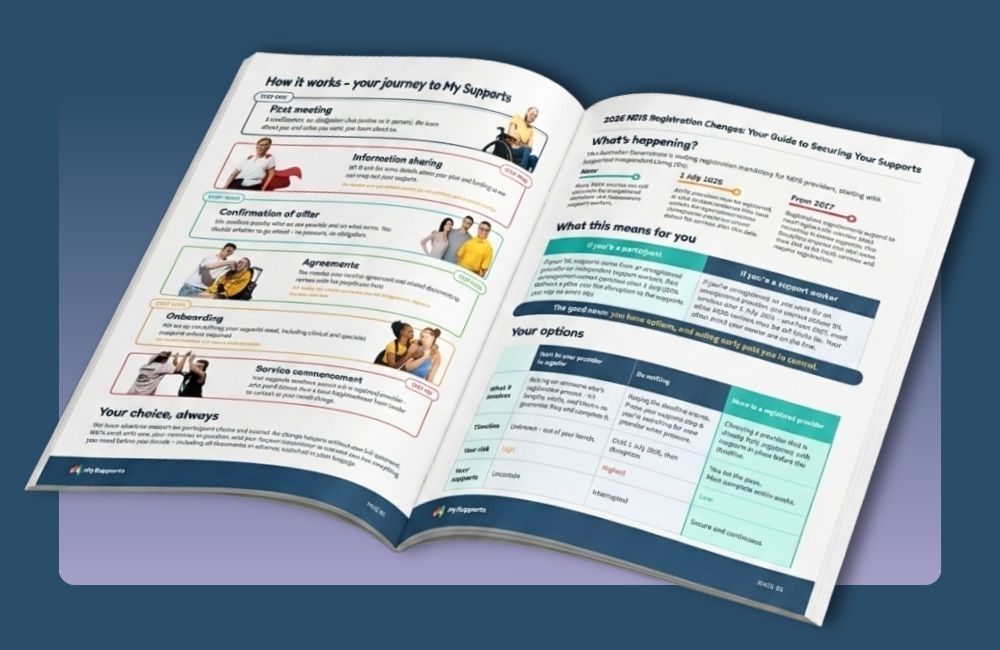
2026 NDIS Registration Changes Guide
What mandatory registration means, your options, and how to secure your supports now that the changes are in effect.
Clear information to help you understand the changes - and stay in control
Since 1 July 2026, big changes have been rolling out across the NDIS. If your supports are delivered by an unregistered provider or independent support workers, those arrangements may no longer be able to continue.
This free guide explains what is changing, what it means for you, and the steps you can take now.
What's Inside
- ✓ What's changing - and the timeline you need to know
- ✓ What it means for participants - and for support workers
- ✓ Your options compared: wait, do nothing, or move to a registered provider
- ✓ Why a fully registered provider gives you certainty and continuity
- ✓ Answers including whether you can keep your current supports
- ✓ A simple next-steps checklist to action now
Who Should Use It
This guide is perfect for:
- 👉🏼 An NDIS participant with SIL or supports from an unregistered provider
- 👉🏼 Parents helping loved ones to secure their supports
- 👉🏼 Support coordinators advising participants on their options
- 👉🏼 Support workers or small providers weighing up registration
Why It Matters
What's changing, in brief
Since 1 July 2026, NDIS provider registration has become mandatory for Supported Independent Living (SIL). If your SIL supports are currently delivered by an unregistered provider or independent support workers, that arrangement can no longer continue as of 1 October 2026. From 2027, registration requirements expand further: the Government has said more than 90% of all NDIS services will eventually require a registered provider.
These changes are designed to strengthen safety and oversight across the Scheme. The SIL deadline has now arrived, and more services follow from 2027. The sooner you understand where you stand, the more options you have.
Who this affects
If you’re a participant: if your SIL supports come from an unregistered provider or independent support workers, that arrangement can no longer continue from 1 October 2026. Without a plan in place, you risk disruption to the supports you rely on every day.
If you’re a support worker: if you’re unregistered – or you work for a provider that isn’t – you can no longer deliver SIL services after 1 October 2026, and from 2027 most other NDIS work may be affected too. For many workers, this is a question about income and career, not just paperwork.
This is a change you can get ahead of. Our free guide walks through your options and what to do next.
Frequently asked questions
What does mandatory NDIS provider registration mean?
From 1 July 2026, providers delivering Supported Independent Living (SIL) have been required to be registered with the NDIS Commission, or be able to show they’ve started the registration process. It’s part of a broader move to strengthen safety and quality oversight across the Scheme.
When do I need to move to a registered provider?
Unregistered providers and independent support workers cannot continue delivering SIL services after 1 October 2026. If that applies to your current supports, the deadline has passed, so it’s important to talk to a registered provider straight away.
What happens if my provider wasn't registered by 1 October 2026?
Their SIL services must stop. If you don’t have a registered provider in place, contact us now. We can help you move quickly and keep your supports going.
Does this affect all NDIS supports, or just SIL?
SIL was first, from 1 July 2026. From 2027, registration requirements are expected to expand to most higher-risk services, including in-home supports – the Government has flagged that over 90% of NDIS services will eventually require a registered provider.
Will my support workers stay the same if I switch providers?
In many cases, yes. Switching to a registered provider doesn’t have to mean losing the people you know – some registered providers, including My Supports, can employ your existing support workers so your day-to-day supports continue with familiar faces.
Not sure where you stand? Contact our team and we can talk through your options.
Get your free guide